Showing posts with label reviews by Liz. Show all posts

Wednesday, June 8, 2016

The Word for World is Forest

By Liz
Book Review: The Word for World is Forest by Ursula K. Le Guin
Official FC Rating: 


My partner, Sean, and I have a lot in common, but an area where we definitely differ is the genre of sci-fi. Sean loves sci-fi. When he isn’t reading something non-fiction, his fiction genre of choice is frequently of the sci-fi variety. Me? Not so much. As much as I enjoy weird elements in the novels I read, with limited exceptions, I’ve never really gravitated towards sci-fi.

Sean highly recommended I read The Word for World is Forest by Ursula LeGuinn, who is a renown sci-fi writer. He told me some of the themes of the novel, and I decided I’d give it a shot. This may sound odd, but I did enjoy the themes of the novel, but I didn’t really like the novel itself.

The Word for World is Forest takes place in the distant future where humans are colonizing other planets in the galaxy. It is implied that we essentially destroyed Earth’s natural resources and thus rely on resources from planets far from Earth (referred to as Terra, in the future). As a logging military branch from Terra colonizes the planet, Athshe, they terrorize, enslave, torture and destroy the habitat of the natives, Athsheans, who are described as being like small men, but covered in green fur and hair. Before the humans, referred to as “yumens” by the Athsheans, arrived, Athshe was known for its peacefulness and was covered in a luscious forest. Led by the Athshean Selver, the Athsheans are eventually left with no choice but to abandon their peaceful nature and strike back against their bloodthirsty masters. The story follows through the war that ends up taking place on Athshe.

A clear commentary on the evils of colonialism, greed, racism, and environmental destruction, the themes of this novel are important, and I very much agreed with Le Guin’s perspective. However, I felt that the execution of the novel itself fell flat for me. It was just too strange for my taste, and I always struggle with novels when I can’t get close to any particular character. Maybe I just don’t get sci-fi, but what frustrated me most was just the odd setting of this novel. I feel like the messages Le Guin gets across loud and clear in this novel could have been made in a setting that was slightly less bizarre.

Ursula Le Guin is a respected sci-fi novelist, and while I didn’t particularly enjoy this novel, I entirely respect Le Guin’s writing and skill. This brand of sci-fi might just not be for me; however, for those that are socially conscious and are also sci-fi fans, this book will be a perfect fit for you. 

Sunday, June 5, 2016

Eleanor: A Novel

By Liz
Book Review: Eleanor: A Novel by Jason Gurley
Official FC Rating: 


How does one single decision, or event, impact the future? It’s a question that many people think at some point or another. Every so often thoughts like these may cross our minds: “What if I had done this instead of that? Could it have prevented that from happening? Could I have done something to change these circumstances? Is it my fault?” These are a few of the questions explored in Jason Gurley’s surreal and heart wrenching novel, Eleanor (which has nothing to do with Eleanor Roosevelt, since I was asked this 800 times while I was reading this).

Long before Eleanor was born, tragedy strikes her family that seems to leave them with a family curse. Then, in 1985, Eleanor’s twin sister tragically dies, which puts her entire family in further emotional turmoil. Eight years later, when Eleanor is 14, she walks through a door in her school cafeteria, and exits into another world. She doesn’t return to her own world until many hours later. From that point onwards, her life is never the same.

You’d think based on that summary that I would understand going in this book was going to be sad, but nope. I was not prepared for ALL OF THE ACTUAL TEARS I WOULD SHED. Gurley certainly did an amazing job conveying emotion and creating stunning images through his words. I loved how he described the other worlds, especially the realm that he calls the rift. It was one of those novels that evoked both feelings and imagery, which makes for a great novel. The novel also deals with some fascinating themes, which Gurley handled in ways that I found both exceptional at points, and disappointing at others.

Death. Alternative universes. A dysfunctional family. Bending of time. These are all intriguing concepts to me that are featured in Eleanor. The themes of this novel actually reminded of a couple novels I read in the summer of 2015, A Tale for the Time Being by Ruth Ozeki, and Norwegian Wood by Haruki Murakami. However, in my opinion, Eleanor differs greatly from those two novels in how the main conflicts in its plot were addressed. Gurley, in some ways, uses escapist plot devices rather than tackle depression, specifically, in any kind of realistic way. I think this is likely a classic case of Deus ex Machina because the conclusion of this novel was almost too satisfying.  

From this point forward there will be some major spoilers. Don’t continue reading if you plan to read Eleanor yourself!

Ozeki, Murakami, and Gurley’s novels all use surrealism in fantastic ways that make you question our own world. Each of their novels have bizarre elements, but unlike Ozeki and Murakami, Gurley uses the other worldly aspects of his story to literally solve the conflict his characters were facing. This brings us back to the main theme of the novel, which is the question of “what impact could one event, one decision, have upon the future?” Gurley’s answer to this in Eleanor is everything. The decision Eleanor’s namesake, her grandmother, made to swim into the sea while she was pregnant, thus killing herself and her unborn child alter her family’s future. This event devastates the family to such a degree that the answer to fixing the problem was, in the end, setting the clock back so Eleanor’s grandmother never kills herself.

It was one of those conclusions that really shouldn’t have surprised me, and admittedly, certain elements of the book became predictable, like Mea actually being Eleanor’s dead twin sister, Esmerelda. I don’t mind predictability in novels (unless it is painfully cliché), but in the case of Eleanor, what bothered me was that the other worlds became the tool to handle problems in Eleanor’s family that are very much the result of real problems we have in society.

Eleanor’s grandmother was very clearly battling depression. She married very young, and got pregnant with Eleanor’s mother shortly after her marriage, which led to her having to drop out of college and quit her passion, competitive swimming. As she is pregnant with her second child, she begins to question her choices, and, to some degree, resent motherhood due to her depression. She doesn’t want to go through a second pregnancy because she feels that, at times, motherhood has taken away some of her happiness, and of her own self.

The depression Eleanor’s grandmother faces, her feelings of disappointment with motherhood, and the fact that she didn’t really want to be a mother to begin with, are real problems that women face today. And Gurley, not only doesn’t address these problems in a meaningful way, but uses Eleanor’s grandmother’s depression as the central point of the whole novel. She was the sole reason the lives of her family members were ruined. I don’t think this is the message we should send to young women. Now, should Eleanor’s grandmother have killed herself? No, but Eleanor’s actions were the reflection of a society that puts too much on women’s shoulders (to put it lightly).

It also leaves the message that a woman should sacrifice everything to put her family first. The novel wouldn’t have necessarily set that message if the novel goes on to show how Eleanor’s grandmother does end up resolving her issues without committing suicide. But nah. It’s just implied that everything gets magically fixed, more or less.

~~End Spoilers~~

From all that, it sounds like I disliked the novel, but I truly didn’t! It was a wonderful, albeit sad, book to read. I do recommend this book, but it’s a novel to be taken at face value. While the novel doesn’t examine societal or philosophical problems in a way I usually prefer, the fantastical elements were grabbing and Gurley’s descriptions were fun in a way that makes you want to draw out the scene. If you’re down for a good cry, or three, and enjoy fantasy, this novel is up your alley. 

Disclaimer: I received a complimentary copy of this book from the Blogging For Books program in exchange for this review. All opinions are my own.

Tuesday, May 24, 2016

Summer Reading List


Memorial day is upon us! Which can only mean one thing... 

A NEW BOOK LIST, OF COURSE! 

We're both looking forward to accomplishing some reading goals this summer. So without further ado... 

Charlotte's Summer Reading List

My summer reading list looks more ambitious than it is. Yes, it’s 16 books. But if we say summer consists of June, July, and August that shakes out to just about five books a month. Which is good, because I planned on reading 60 books this year. (Actually – I am behind! I’m only at 23 right now. But I’ll catch up.) I didn't go with any particular summery theme. I've actually read a lot of "junk" books lately, so.. I should use the summer to make up for it. Plus I'm not going to be on the beach this summer! I'm going to be in the mountains. I don't know why that makes a difference in my mind when it come to what genre to read, but it does!! Nonsensical. I imagine Les Mis will take at least a week and a half, and that’s if I’m really devoted to it. But a lot of the others should be easy reads to make up for it. At least five of these books are kids’ books, and a few are rereads for me, so that makes it go a bit faster. 

1. Les Miserables by Victor Hugo

This is on my list of books to read in my twenties. I’ve decided I’d like to read it this summer because… well because I keep watching and loving the movie. It’s time. Also, I was reading a bit about John Brown today and I came across this quote from author Victor Hugo: 

“Politically speaking, the murder of John Brown would be an uncorrectable sin. It would create in the Union a latent fissure that would in the long run dislocate it. Brown's agony might perhaps consolidate slavery in Virginia, but it would certainly shake the whole American democracy. You save your shame, but you kill your glory. Morally speaking, it seems a part of the human light would put itself out, that the very notion of justice and injustice would hide itself in darkness, on that day where one would see the assassination of Emancipation by Liberty itself.” 

So it’s another reason to love Victor Hugo, and it’s pushed me to read his book sooner rather than later. 

2. Jane Eyre by Charlotte Bronte 

One of my general life goals is to read more classics. Jane Eyre is a classic! Not only that, but Liz challenged me to read three of her favorite books of 2015, and this is one of them. Two birds, one stone. Of the books Liz challenged me to read, I initially chose this one to be first since “I have it already!” Well I took a look through my books today. It turns out I do not in fact own it. BUT tis easy to retrieve from the library. 

3. Pride and Prejudice by Jane Austen

I know I’ve mentioned this about 500 times on here, but man. I can’t finish this book! WHY? It’s a mystery. It’s not even as though I don’t like it – so far, I do!! But I just haven’t finished despite reading it for over a year now. What’s wrong with me? I’m vowing to finish it this summer. If I don’t, I’ll have disappointed myself and all of you. 


4. Adulting by Kelly Williams Brown

I’m about half way through this book and I am mostly enjoying it, though sometimes it irks me. I’ll explain more when I finish it and write a review. But I most definitely intend to finish it this summer. 

5. The Silmarillion by J.R.R. Tolkien 

This will be the first time I’m reading The Silmarillion. I’ve loved each book I’ve read of Tolkien’s, so I’m excited about this one. And I found it nice and cheap at a used book store. ;) 

6. The Fellowship of the Ring by J.R.R. Tolkien
7. The Two Towers by J.R.R. Tolkien
8. The Return of the King by J.R.R. Tolkien

Rereads for me. Very excited. May have to have a movie marathon, too. 

9. The DaVinci Code by Dan Brown
10. Angels and Demons by Dan Brown

I already own The DaVinci Code and have read some of it. I loved both of the movies. I’m constantly telling myself to read these two, and yet, I never do. WHY? It’s time. 

11. The Money Book for the Young, Fabulous, and Broke by Suze Orman 

Because help. 

12. Percy Jackson and the Olympians by Rick Riordan: 
The Lightning Thief
The Sea of Monsters
The Titan’s Curse
The Battle of the Labyrinth
The Last Olympian

This series has been on my list since a kid I worked with told me I “NEED TO READ THEM.” The kid also loved Harry Potter and LOTR so I’m going to go ahead and give this series a try.

Liz's Summer Reading List

So, my list is significantly shorter than Charlotte's because: 1) I am easily distracted and 2) my work life is nuts, but slightly less nuts in the summer. That being said, I can probably manage two books a month from June through August, maybe more if I am lucky and/or learn how to manage my time better. This will keep me in line with my reading goal for this year.

I have a tendency to read lighter reads in the summer, like YA novels. But this summer, I really just need to continue to make a dent in all of these books I have literally piled up throughout my apartment that I have yet to read. That being said, the books that have made my list are books I definitely want to have read this summer. If I can get to more books, awesome, but these are the one's that I'm prioritizing.

1. The Happiness Project by Gretchen Rubin

This is the book I am currently reading, and I am getting a lot out of it so far! I'm a decent way through the book, but it's unlikely I will finish this before June (this time of year is literally the busiest time of year for me at work), so this will be my first summer-read to complete. It's already making me think differently about how to be happier and what lifestyle changes I should aim to make. It could lead to some productive self-development projects this summer...

2. After Dark by Haruki Murakami

Y'all should be proud at how long I've held off from reading another Murakami novel. Anyway, I read somewhere that May is short story month, so I intended to start reading this short stories collection by Murakami two weeks ago. Naturally, I've had essentially no time to add another book to read for this month, so chances are I won't get my start on this until next week in June. I've heard excellent things about After Dark - I think it'll be a great first read for summer 2016! #cantstopwontstopreadingMurakami

3. Ada by Vladimir Nabokov

I love Nabokov's writing - he's easily one of my favorite authors of all time. This has been written  by others time and time again about Nabokov, but his writing style is so beautiful. I've also said this before, but I love a book that forces you to think critically, and Nabokov's novels never fail to do this. I'd even say his novels are actually what constitutes a perfect novel. The plots are always captivating, his themes always reveal something meaningful about society and human nature, and the writing is sophisticated while still being accessible. I read Lolita for the first time a few summers ago; Ada should make for an excellent summer read as well.

4. Harry Potter by J.K. Rowling

The whole series would be god damn ambitious for me to finish in one summer (though it would be possible if I didn't want to read as many other things). BUT, I want to start reading the books this summer along with my other reads. It'll be nice to have something easy and pleasant to alternate reading with my other books. I'd also like to be able to stretch the series out through the fall, because what better time of year to read HP than the fall?? Lastly, and most importantly, Charlotte would actually kill me if I didn't start reading them this summer.

5. At the Water's Edge by Sara Gruen

It has been a hot minute since I read Sara Gruen's Water for Elephants, but I remember how much I had absolutely loved it. Water for Elephants was definitely one of my summer reads when I had read it, and At the Water's Edge is right up my alley for a traditional summer read. It has romance, some historical fiction, and fantastical elements (it features the Loch Ness monster! I'm sold).

6. Go Set a Watchman by Harper Lee

I have been waiting to read this since it was announced that it was finally going to be published. Earlier this month I was able to get my hands on a really cheap copy, so now it is finally time to get my eyes on those pages! To Kill a Mockingbird is, obviously, a classic, and it has also always been one of my favorite go-to summer reads. This summer, I finally will get to learn about Scout as an adult, and also get to see her father, Atticus, in a new light.

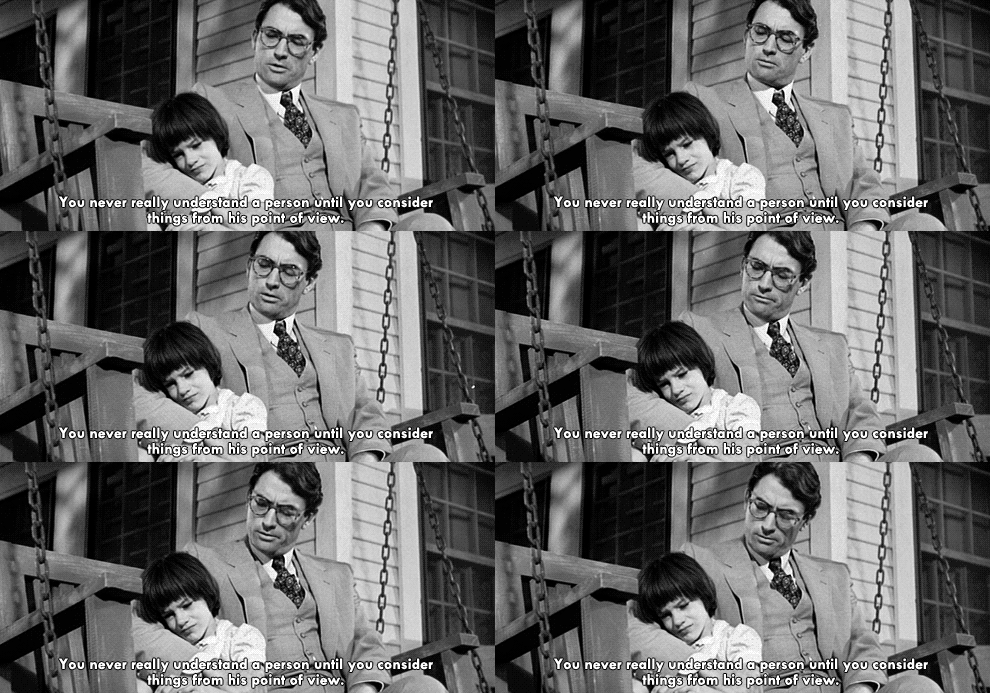
Let's talk about how sexy Atticus was in the To Kill a Mockingbird movie adaptation. So sexy.
7. Farewell Summer by Ray Bradbury

I plan to make Farewell Summer my very last book to read this summer. I know you're probably rolling your eyes and thinking, "wow how corny!" But hear me out first. Farewell Summer is Ray Bradbury's long awaited sequel to his novel, Dandelion Wine. Dandelion Wine is meant to be read in the summer. It's a collection of short stories that take place during the summer in a small midwestern town, and the stories center around two young brothers and the people in their community. Ray Bradbury's writing makes you feel summer. Bradbury's descriptive writing style is so perfect, it's as if you can feel the summer breeze in your living room, and can smell the dirt on your hands. In Dandelion Wine, he captured the essence of childhood summers. SO, with that said, Farewell Summer will likely encapture the transition of summer into fall and winter in a beautiful way to conclude my own summer.

Sunday, February 21, 2016

The Tsar of Love and Techno: Liz's Review!

By Liz
Book Review: The Tsar of Love and Techno by Anthony Marra
Official FC Rating: 


By now, you may have read Charlotte’s excellent review of The Tsar of Love and Techno, so you’re aware that she absolutely loved it. While she was reading it, she highly recommended it to me as well, so I decided to make it my final read of 2015. Let me tell you, I was not disappointed!

At the end of 2015 this book could be found on nearly every “best of 2015” list, and for good reason- it is phenomenally written. Charlotte mentioned how she would occasionally have to put this novel down to pause and just take in the writing, and I found myself doing the same. The writing, and the storytelling, leaves a remarkable impression.

Set in Russia, The Tsar of Love and Techno, a collection of stories that weave together to become one, is about love, politics, the complicated nature of choice, and how a community is connected together over the course of generations. Anthony Marra brilliantly weaves the stories of an artist, a ballerina, a soldier, and many others by connecting them to a single object.

The stories were mind-blowing. I was literally in awe following the end of the first story and the end of the last story. Marra’s writing makes us question, “what really happened here, and what did it mean,” at various points in the novel. A talented writer often will allow a reader to have a certain amount of freedom to wonder and answer things for themselves- Marra has truly nailed this.

Unlike Charlotte, I hate to say that this, I didn’t love every single story in the collection. The first story absolutely blew me away, and the last story had the same kind of impact on me as the first. There were a few in between stories I enjoyed, but none impacted me quite the same as the first and last, unfortunately.

I am not well versed in Russian history, so I occasionally found myself confused at some of the references and googling quite a bit. This isn’t necessarily a bad thing, it just made me want to know more. It also sparked great conversations between me and my partner. He helped me understand the differences between Trotsky and Lenin, and the conversation inspired me to read more about Marxism. I love it when a book makes you think and learn about things you may not have otherwise thought about.

Another big plus about this book was the cleverly inserted humor and references to pop culture. This book literally made me laugh and cry, which is not something that many books accomplish!

The Tsar of Love and Techno will have you all over the emotional spectrum- in a good way! It covers a broad array of themes and will challenge you to think differently. As many before me have said, this book is worth reading. 
___
Liz

Disclaimer: I received a complimentary copy of this book from the Blogging For Books program in exchange for this review. All opinions are my own. 

Sunday, January 3, 2016

Our 2016 Reading Goals


For avid readers, the New Year means new reading and book-related goals- and we are no exception!

In addition to listing out our reading and book-related goals for 2016, we’ve decided to do something a little interesting- at the end of each of our lists, we will be putting down our reading challenges for each other. So, without further ado…

Charlotte’s 2016 Reading Goals

One of my big goals for 2015 was to read more. Another was to get better at habits, following through, not procrastinating, etc. SO with those things in mind – I actually achieved the reading goal. I think it might be the first time ever that the number of goals I achieved is greater than the number of goals I fell short of achieving!!!

Preeeetty cool.

I read 34 books last year. I want to get to a place where I’m reading between 40 and 50 books every year (like, as a lifelong habit regardless of where I’m at in life – I want it to be one of those things that just is, even when I’m swamped with work or relationships or kids). We’ll see! But this year I agreed to do a 60 book challenge. LOLOL. I 50% have faith in myself, 50% am laughing. Like last year, though, I’m not swimming in a pool of obligations, so if I’m ever going to read that many books, this would be a good year to attempt it.

I do have a few specific reading goals:

1.    Again, read 60 books. Plays count. Short stories count if they’re in a collection. My friend Dana and I came up with these parameters. We’ll have to also be each other’s cheerleaders because reading 60 books is a lot.
2.    I WILL FINISH Pride and Prejudice. …….It might finish me, too. I was reading it in late December, but I’ve put it down for the time being. I’m distracted lately so I think I’ll do better with a non-classic at the moment.
3.    Read The Divine Comedy. This is on my list of books to finish in my twenties AND Pope Francis has recommended that Catholics (or anyone! Yay everyone! <3) read the three books during this Holy Year of Mercy. So this is the year to cross these masterpieces off my list (I’ve read and loved Inferno- very much looking forward to the others).
4.    Review at least half of the books I read. One of my personal writing goals is to post at least 45 reviews, but some of those will be for books I’ve read in the past. But I’m really into writing reviews right after reading books because I’ve noticed it’s made me a more critical and mindful reader, and I’m really enjoying that. So I’d like to review a lot of the books I read this year (ties back into my new lifestyle mode of not procrastinating, dammit!).
5.    Read at least five Catholic books. I do much better with life in general when I’m reading religious stuff, plus I think it makes me a better person.
6.    Read more funny non-fiction. My life feels overwhelming at times, seeping right into my personality and my activities and everything. I need to have more fun. Laughter is the best medicine and I think me needs some.

And now for my challenge to Liz! Liz is basically family at this point but I still throw her shade because her ass hasn’t read Harry Potter. I’ve been peer-pressuring her to read Harry Potter for as long as we’ve been friends, and THIS B STILL HAS NOT. I feel my blood pressure rising just thinking about this bogustry. As soon as we decided we’d give each other one challenge for 2016, Liz knew I was going to challenge her to read Harry Potter. Wrong she was not. It’s time. Liz, hop on the Hogwarts Express. Welcome to Hoggy Warty Hogwarts.

Liz’s 2016 Reading Goals

Like Charlotte, for 2015 one of my goals was to read more. I’ve always been a pretty consistent reader, but between balancing work, school, and internships for years when I was in college, I fell out of the habit of seeking reading as a hobby. Now that I have a stable job, 2015 was the year I kind of fell in love with reading again (not that I ever fell out of love with it, but I was able to pick it up as a regular hobby again).

In 2015 I also started to become a more critical reader, which I like a lot, and I want to hone in on these skills in 2016.

Now that I’ve started reading more, one of my top priority goals for this year is to diversify the kinds of books I read. I want to ~learn~ things.


My specific goals are:

1.    I’d like to read at least 20 books this year, so on average 1.5 to 2 books per month. I have to confess…this was my goal last year too. I got pretty close! I got to 16! And some of those books were massive! (*cough* 1Q84 *cough*). So, this year I’d like to actually hit my 20. Charlotte and I differ in opinion when it comes to massive reading goals. I don’t care as much about numerical goals as other readers because to me it’s more important to really understand and absorb what I am reading. If I am rushing to read just to hit a numerical goal and consequently fewer books really stick with me, is it worth having that goal? 20 seems like a reasonable goal given all of the various things I have going on in my life. This year I will do it!
2.    I want to write more book reviews. While I did review a good chunk of the books I read in 2015, I want to get better about writing reviews shortly after I’ve finished reading. When I wait too long to write a review, I feel like my review ends up being lower in quality. This year I want to give myself no more than 2 days after I finish reading to write my reviews.
3.     I want to read more non-fiction books. I have so many. SO. MANY. Just sitting on my bookshelves that I haven’t read. I’m guilty of seeing a non-fiction book in a store and being like “ooh this would be GREAT for my environmental science and policy collection”….and then never actually reading it. Well, not this year! I’m going to start digging into some of the non-fiction I own.
4.    I want to complete a reading challenge. This will force me to diversify the kinds of books I usually gravitate towards. I’m committed to doing this challenge.
5.    Of the non-fiction genre, I specifically want to read more books on political theory.

And now, for my challenge for Charlotte. Since Charlotte’s such an avid reader, and since she’s challenged me to read the entire HP series (which I look forward to doing!), I am challenging Charlotte to read at least three out of the five books I listed as my favorites for 2015. This means Charlotte doesn’t have to read Murakami…but she should. She should read Murakami.  

And that’s a wrap for us! We will fill you in on our progress along the way!


Char & Liz

Thursday, December 31, 2015

Our Favorite Reads of 2015


After seeing a slew of articles circulating the interwebs titled "The Best Books of 2015," etc., we knew that we needed to do our own. We've had quite a productive reading year! Charlotte read over 30 books, and Liz read 16! We've read some really crap books, but, more importantly, we've read some truly excellent books that will stay with us for years to come. Here's each of our top five for 2015!

Charlotte's Top 5 Books of 2015

5. The Underland Chronicles by Suzanne Collins

Okay, okay. This is technically five books. I’ve reviewed three of them so far: one, two, and three. They weren’t the most spectacular books I’ve ever read, but they left a mark. I can always dig a book about rebellion, about ending oppression, about equal rights. I enjoyed this myself, and I know it’s something I can share with the tiny humans in my life: siblings, nieces and nephews, my own kids one day. Books that teach kids about these things make me happy. 

4. The Martian by Andy Weir

Now, this was a damn good book. An astronaut gets stranded on Mars after his crew mistakenly thought he was dead. It’s a story of survival and resilience and the worth of human life. Without giving much away, I’ll say that our protagonist must try and stay alive and his team, as well as hundreds or thousands of people on earth, need to figure out if there’s any way to save him.

I loved this book a lot. It was thrilling yet smart. There are some books I just devour, but they don’t make me think much. This book is jam packed with science and logic but is written in such a way that those of us without degrees in rocket science can still understand it. It’s a real adventure. It’s one of my favorites for the year because it kept my adrenaline pumping; I couldn’t put it down.

3. Why Not Me? by Mindy Kaling
I wouldn’t necessarily call this a crucial book, but if you’re looking for something from a female role model who doesn’t fuck around, this is a great place to start. I loved it because it was hilarious, but I also gleaned some insight from Kaling’s experiences. Her first book was also terrific, but this offered a more grown up attitude while maintaining fast paced humor. I’ve been a fan of Mindy Kaling for a while, and I hope she never stops writing books. This book is top five for the many, many laughs as well as the insights. Highly recommend. (And I reviewed it here.)

2. Better Than Before by Gretchen Rubin

I haven’t reviewed this book yet, but I did write a few things about it in this post.

Gretchen Rubin is my favorite author for this genre. She combines research, history, and experience to form really great advice to change habits. This book left me feeling more optimistic about my chances to actually improve and gave advice that was actually possible to implement.

And finally, my best book of the year:

1. The Tsar of Love and Techno by Anthony Marra

Just, let’s not get me started on this book again. It’s phenomenal. The writing is unbelievably good, the stories are terrific. I couldn’t put it down. The writing will just blow you away. I reviewed it here and I talked about it a bit more on my personal blog right here.

Liz's Top 5 Books of 2015

When Charlotte and I were discussing this post the first thing she said to me was “so your entire list will be Murakami.” HAHA, CHAR. VERY FUNNY. While she’s spot on, 2015 became the year I discovered Murakami and he became one of my favorite authors, my top 5 is not all Murakami. This list is compiled of the books I read this year that will be the books that stick with me for years to come- the ones I’ll bring up in conversation (and constantly recommend), the ones I’ll think of when I’m reading a different book that shares a similar element, and the ones that drew intense feelings and thoughts from within me.

5) Jane Eyre by Charlotte Bronte

Jane Eyre was a pleasant surprise (I was wary given my bad history with other novels of the same period). While I haven’t seen any film depictions of the novel, I assume they focus almost wholly on Jane’s relationship with Rochester, but Jane Eyre is not a romance novel. Jane Eyre is a survivor, a woman that bucks the norms of her time, strong willed, intelligent, and honest. Jane Eyre is entitled after the main character because it’s about her life, and her life is more than just the man she ends up falling in love with. It is about the abusive household she was raised in and survived through, how she came into her own at a strict and unforgiving boarding school and the important relationships she built while there, how she questioned women’s preordained roles in society and challenged them on the basis that women have the same wants and skills as men, and finally, how she found true love despite trying circumstances that would ordinarily keep two people apart.

From the beautiful writing to the themes that still hold true today, Jane Eyre as a novel, and as a character, will stick with me for years to come.

4) 1Q84 by Haruki Murakami

I was torn between including 1Q84 and Kafka on the Shore for this list. As I’ve written before, Kafka on the Shore is the Murakami novel that pieced together the puzzle for me- it’s the novel that made me finally feel like I was starting to truly understand what Murakami is all about. But it’s 1Q84 that has made my list because it’s the first Murakami novel I read. As I’ve continued to read Murakami novels, and even works by others, 1Q84 frequently comes to mind. 1Q84 was, in some ways, a challenging novel as an introduction to Murakami’s works, but as I’ve continued to read his novels, I gain a better understanding of 1Q84 as I reflect on it.

1Q84 is a combination of a dystopian, sci-fi, fantasy, and love story all wrapped into one novel. The story follows Aomame and Tengo as they navigate some kind of parallel universe, which Aomame calls 1Q84. As they try to figure out this strange new world, Aomame’s and Tengo’s paths eventually come closer and closer together. Aomame has become one of my favorite female literary characters, and as I’ve read more of Murakami’s novels, I would argue that Aomame is the strongest female character he has ever written.

1Q84 is complex, fantastical, confusing, and both heartbreaking and beautiful, which is why it makes my top five of 2015.

3) The Handmaid’s Tale by Margaret Atwood

If I could only choose one word to describe The Handmaid’s Tale it would be “terrifying.” Published in 1985, this dystopian novel is frighteningly relevant to today. In the future, a supposed terrorist attack takes place (blamed on Islamic extremists) that ends up killing the President of the United States and most of congress. This gives the opportunity for a religious extremist group, the “Sons of Jacob,” to put forth a revolution and take over the government. This new world strips women of all human rights and creates new class divisions. The story is shared by the protagonist, Offred, a handmaid that was assigned to the household of Fred (thus her name, Offred). Due to declining birth rates, Handmaids are assigned to upper class households for  reproductive purposes.

Through flashbacks of Offred’s life prior to and after the revolution, we are introduced to a world of rampant pollution, sexism, and religious extremism. This book is one of my favorite reads of 2015 because, especially given the dialogue that has taken place during this presidential election season, it’s themes of environmental degradation, the desire of men to control women’s lives and bodies, and class warfare are more important to understand than ever. Atwood’s novel is not a cautionary tale about our future- it’s a warning about the present.

Nolite te bastardes carborundorum. Don’t let the bastards bring you down.

2) A Tale for the Time Being by Ruth Ozeki

For those of you who are familiar with Doctor Who, you probably will recall one of the Doctor’s famous lines about the nature of time: “Time isn’t a straight line...time is more like wibbly wobbly...stuff.” A Tale for the Time Being is a superb novel that will make you question the nature of time and how we are all connected.
This novel is told through the narrative of Nao, a teenager who was born in California that is forced to move to Japan, where her family is originally from, when her father loses his job, and Ruth, a Japanese-American writer who lives on a small island off the coast of British Columbia. Nao’s story is told through her diary, and Ruth’s story is told as she is reading Nao’s diary, which she finds one day on the beach. As an American, Nao is treated by her peers as a foreigner, and consequently she is relentlessly bullied while she is in Japan. Her father struggles to find a job and is thrown into a deep depression. After he tries to commit suicide numerous times, Nao’s own mental health is greatly impacted. Ruth finds Nao’s diary while she is in the middle of severe writer’s block. Nao's diary takes Ruth on a crucial journey to possibly save Nao, while also saving herself. While Ruth and Nao's stories are on different timelines, the two are connected both literally and figuratively in ways that, at times, will boggle your mind.
Thrilling, thought-provoking, and emotional- this novel will stand the test of time for me.
1) Norwegian Wood by Haruki Murakami

Norwegian Wood, which I recently reviewed at length, is my favorite book of the year. Beautifully written, touching, and relatable, I could hardly put this book down. Murakami’s insightful words on death and the importance of love leave a lasting impression. As someone who has experienced death, when I read Toru’s thoughts as he was trying to understand death himself, I thought “yes, exactly, this is precisely what this is like.” This book is not only a favorite for this year, but possibly one of my all-time favorites because when I recall this novel, all the feelings it gave me come flooding back.

Liz & Char

Wednesday, December 30, 2015

Norwegian Wood

By Liz
Book Review: Norwegian Wood by Haruki Murakami
Official FC Rating:


When I was having a particularly rough day, my partner offered to get me a book while he was visiting one of my favorite bookstores that evening. I was in a negative place at the time- I had just had my terrible experience with The Bookshop, work was particularly stressful- I needed something I knew would be a comfort. At the time I had already read three of Haruki Murakami’s books (this is now my fourth) and loved them each, so I felt safe asking for Norwegian Wood.
Despite already feeling confident I’d enjoy this novel, somehow it still managed to surpass my expectations. It’s been years since a book has touched me like Norwegian Wood. When I finished reading, like I usually do, I skimmed some reviews on Goodreads. This review explains how I felt about this novel well:
“There are some books you read, which leave you with stories-bitter, exciting, adrenaline-driven, romantic, depressing or grisly. And then there are books which leave you with feelings. Norwegian Wood, most definitely, belongs to the second category.”
Norwegian Wood has sometimes been described simply as a love story, and other times as a coming-of-age story, but leaving the description to those terms is far too narrow for the scope of this work. Norwegian Wood is about our protagonist, Toru, as he learns to navigate the complicated worlds of death, love, life, and how each of these worlds intersect.
My dad died when I was 17. My mom got a call at 3 AM on April 29th, 2009, and I woke up to her crying- my dad had a sudden heart attack. In Norwegian Wood, Toru’s best friend, Kizuki, commits suicide on his 17th birthday. As Toru learns to cope with, and understand, death, I related greatly to his insights and feelings, especially since we both experienced loss during the same age period. When I read the below excerpt, I got chills- these words truly resonated with me:
"Death exists...and we go on living and breathing it into our lungs like fine dust."
Like Toru, after my dad died life and death became much more complicated concepts. Once you lose someone, so much of your very being changes. What touched me the most about this novel is how well it captures the impacts of death on your mental health, how you view the world, and how important it is to hold your loved ones close.
From the very first page of this novel, I noticed that stylistically it was very different from the other Murakami novels I’ve read. At first I thought that maybe it was because this novel was written by a different translator than the other Murakami novels I’ve read, but I don’t think this is the case because there were points in the novel where I thought “ah, here’s the kind of Murakami writing I am used to.” All of that being said, this novel is beautifully written in every way, from the story itself to the style of writing. I thought this particular excerpt was remarkably poetic and visual:

The more Murakami I read, the more I feel I am getting a grasp on his writing and what he is about. Like Kafka on the Shore (which I reviewed on GoodReads), Norwegian Wood was one more Murakami novel that helped me understand his various themes and philosophies. In this novel, and in his other novels, music, the importance of exercise, and the necessity of love, especially through trying times, are all themes throughout the text. Additionally, in my review of Kafka on the Shore, I mention how Murkami consistently resolves any possible monetary issues his lead characters could encounter and how I felt that he did this purposely so his characters would be free to develop themselves without restrictions. My suspicion of this was confirmed in Norwegian Wood.
Norwegian Wood is much more contemporary than Murakami’s other novels- it has less fantastical elements and is more grounded in reality. So, class issues were brought up in a very different way than his other novels. I feel the best example is through Midori’s struggle. Midori, one of Toru’s love interests, grew up in a working class neighborhood and worked her whole life in her family’s small shop. She was sent to private school and constantly felt ostracized because she couldn’t invite friends over to her small home, or couldn’t always go to a friend’s home. Midori frequently discusses how her family’s financial struggles greatly dictated how she could develop in life. On the opposite side of Midori is Toru’s friend, Nagasawa, who is exceptionally wealthy and, consequently, aloof, uncaring, and selfish. Both these characters emphasize how money can impact one’s development.
Class is also alluded to in other ways in the novel. For example, Toru often discusses how his favorite novel is The Great Gatsby. It’s no secret that The Great Gatsby is about how the American dream is unattainable- that it is impossible to both prosper under capitalism and maintain healthy and loving relationships. Without spoiling too much, the story of Nagasawa and his girlfriend, Hatsumi, very much mirrors the story of The Great Gatsby.
Norwegian Wood is frequently compared to The Catcher in the Rye, which makes sense given the themes they have in common. The main characters of both novels deal with internal struggles following the death of a loved one, both novels have themes regarding mental health, frustrations with society, and class issues.  The frustration of hypocrisy in society is an area where I felt the two novels were most strongly connected. At one point Midori shares with Toru a story about her experience joining a revolutionary student group on campus. She discusses how despite the students being highly educated about the theories of Marx and various other political theorists, none of the students had the patience to actually teach or discuss those theories. What angered Midori the most was undoubtedly how women in the group were treated in comparison to the men. This supposedly radical and progressive group still would make the women prepare meals for the meetings and would silence the women from actively taking part in discussions.
Finally, you can’t discuss a Murakami novel without discussing the importance of love. While figuring out how to cope with the death of Kizuki, Toru falls in love with Kizuki’s high school girlfriend, Naoko. Both Naoko and Toru truly get close after Kizuki’s death, however, the way both of them are able to handle his death is very different. Naoko and Kizuki knew each other since they were children. Having grown up together, she never felt they would be apart. After Kizuki dies, Naoko battles severe anxiety and depression that render her incapable of being in the “normal” world. Naoko checks herself into a sanitorium in a rural, mountainous region of Japan, where Toru keeps in touch with her via letters and occasional visits. While Naoko and Toru are apart, Toru eventually meets Midori, who in many regards is the total opposite of Naoko. WARNING: SPOILERS AHEAD!! I feel that Toru’s relationships with Naoko and Midori represent the different phases he enters following Kizuki’s death. Towards the end of the novel, while Toru still very much loves Naoko, he realizes that he is very much in love with Midori and wants to find happiness in life with her. By deciding to commit to Midori, this moment symbolizes that Toru is finally beginning to heal from Kizuki’s death.
Each paragraph I’ve written could easily be their own essays, and I could even go into more, but allow me to wrap this up (if I haven’t already bored you to death). This novel can get nothing less than five stars from me. It has everything you could want in  a book- an excellent plot and characters, complex and interesting themes, and beautifully written language. I laughed, I cried, and I related- this novel goes down as my favorite of the year.